Clear Thinking: The Art and Science of Making Better Decisions
- Author
- Shane Parrish
- Published
- Penguin, 2023
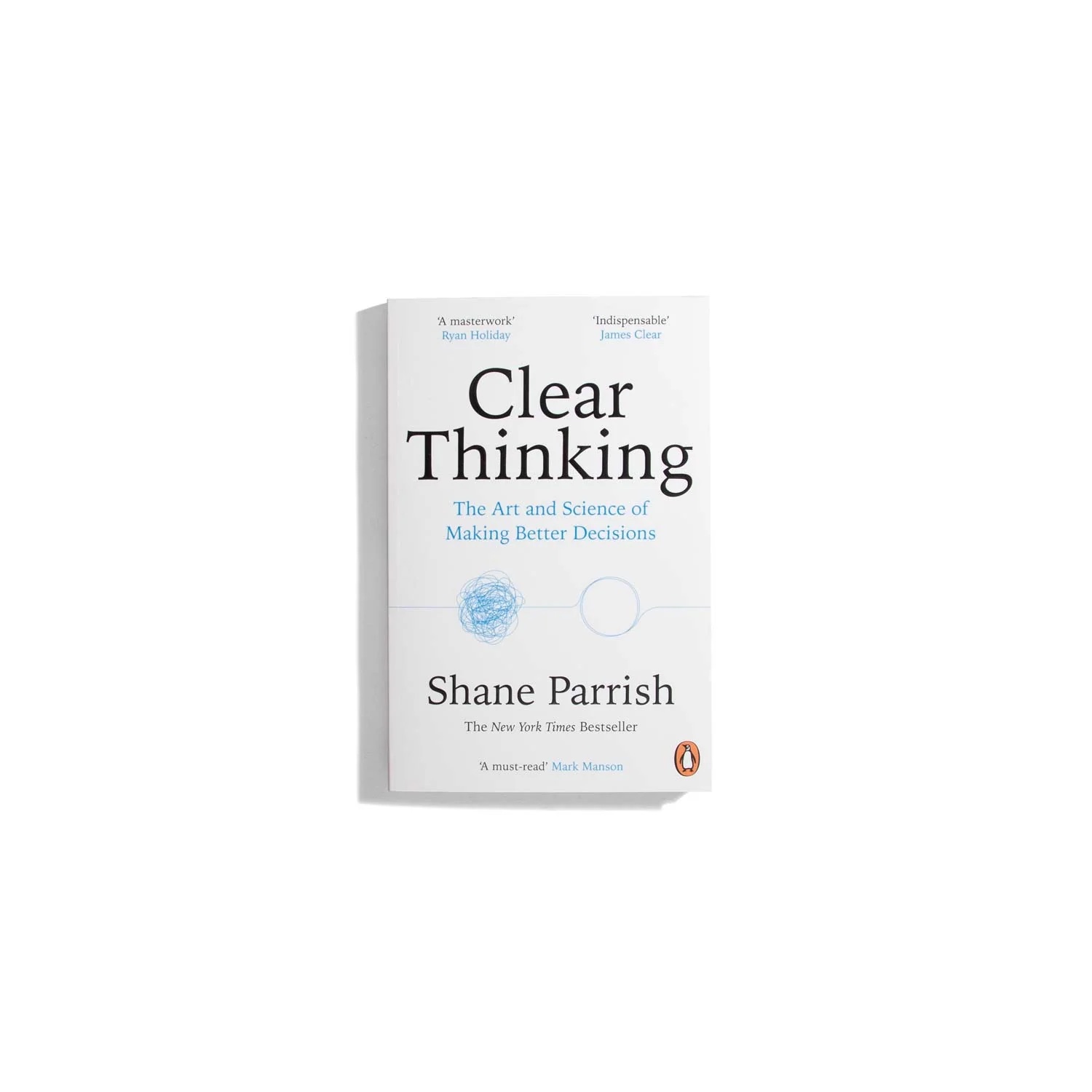
Most people think decision-making is about big decisions: the job offer, the investment, the move across the country. Shane Parrish began asking a question while working at an intelligence agency, where lives were at stake: “Why do some people consistently get better results than others who have the same information?” He spent years exploring the question through his blog, Farnam Street, and conversations with thinkers such as Charlie Munger and Daniel Kahneman.
His answer is less glamorous than most decision books. Good judgment, he argues, is mostly won or lost in ordinary moments: the reply sent in irritation, the meeting that drifts, the habit nobody questions. By the time a big decision arrives, the position from which it is made has already been set by hundreds of small ones.
Time is the friend of someone who is properly positioned and the enemy of someone poorly positioned.
The enemies: four defaults
The book begins by naming what gets in the way. Parrish calls them defaults, reflexes built into human nature that act before reasoning has a chance to:
- Emotion. Responding to feelings rather than reasons and facts.
- Ego. Promoting and protecting self-image at all costs.
- Social. Conforming to the norms of the group.
- Inertia. Resisting change and preferring the familiar.
The danger lives in the space between stimulus and response. Either reason fills it, or a default does. Then comes a useful twist: defaults cannot be eliminated, but they can be reprogrammed. The same reflexes that cause trouble can be trained into habits that work in your favour.
Building strength, managing weakness
The next step is learning how to do that. The four strengths are self-accountability, self-knowledge, self-control, and self-confidence. They are built less through willpower than through standards. People become like those around them, so Parrish recommends choosing exemplars deliberately and practising what they do.
Strength has limits, so the book pairs it with safeguards: five strategies that change the situation rather than the person. Prevention, such as the HALT check before deciding anything while hungry, angry, lonely, or tired. Automatic rules. Friction that makes counterproductive behaviour harder. Guardrails. And shifting perspective. A short chapter on mistakes adds a fair challenge: when things go wrong, the instinct is to blame the world, and the better habit is to look first at one’s own part.
Decisions in action
Only then does the book turn to decisions themselves: define the problem, explore solutions, evaluate the options, and act. Each step comes with named principles that are easy to remember:
- Root cause. Solve the problem, not its symptom.
- 3+. Explore at least three options; considering only two is a sign of a blind spot.
- HiFi and HiEx. Seek information close to the source and from people with real expertise.
- ASAP and ALAP. If a decision is cheap to undo, make it as soon as possible. If it is costly to undo, make it as late as possible.
- Process. Judge a decision by how it was made, not only by how it turned out.
Two closing chapters complete the set. Margin of Safety argues for leaving room for error when failure is expensive, illustrated by the collapse of the hedge fund Long-Term Capital Management. Learn from Your Decisions turns every outcome into feedback.
Wanting what matters
The book saves its best for last: a closing section that changes the meaning of everything before it. Parrish separates two skills: knowing how to get what you want, and knowing what is worth wanting. The first makes decisions effective. Only the second makes them good.
All good decisions are effective, but not all effective decisions are good.
Through Scrooge, the gerontologist1 Karl Pillemer’s interviews with older people about living well, and the old practice of memento mori2, the book turns toward time, relationships, and regret. The defaults, it turns out, shape not only how goals are pursued but which goals get chosen in the first place. The social default chases what others admire, such as a prestigious career that brings no joy. Inertia keeps someone working toward a goal set at 22 that no longer matters at 35. Emotion chases whatever feels exciting in the moment, such as a new plan every month, while the goals that matter most wait. Ego accepts a promotion that brings only misery, because turning it down would feel like failure. The lesson is captured in one line: “Wisdom is turning your future hindsight into your current foresight.”
What remains
The book’s real value shows up after the last page. Once the defaults have names, they become hard to miss: a reply shaped by emotion, a position defended out of ego, a plan kept alive by inertia. They show up in friends and colleagues, and, less comfortably, in oneself. Naming these states makes it possible to step outside them and look from a third-person perspective, which is what reflection is. That self-knowledge has a practical payoff: important decisions can wait for a calm, clear state of mind instead of being made in a bad one.
The book is also right that defaults set goals, not just behaviour, and that knowing what is worth wanting matters more than knowing how to get it. The hard part is finding the calm to work that out. Defaults, along with social media and everything else competing for attention, crowd out the quiet that real reflection needs. Knowing what brings happiness depends on that quiet, and making room for it is worth the effort.
The bottom line
Clear Thinking changes how one sees more than it hands out rules. The book persuades through stories more than it proves through research. But its framework is easy to remember and easy to use: notice the default, create the pause, and ask whether the goal is worth wanting. It is recommended for anyone who wants to understand themselves well enough to decide better, and to make room for the reflection that reveals what actually matters.